Turning high-school students' curiosity into engaged writing
# education
How California’s 2024 Teacher of the Year uses ChatGPT to help students elaborate, argue, and care
ChatGPT is helping California’s 2024 Teacher of the Year, Casey Cuny, spark curiosity by turning students’ passions into writing and inquiry.
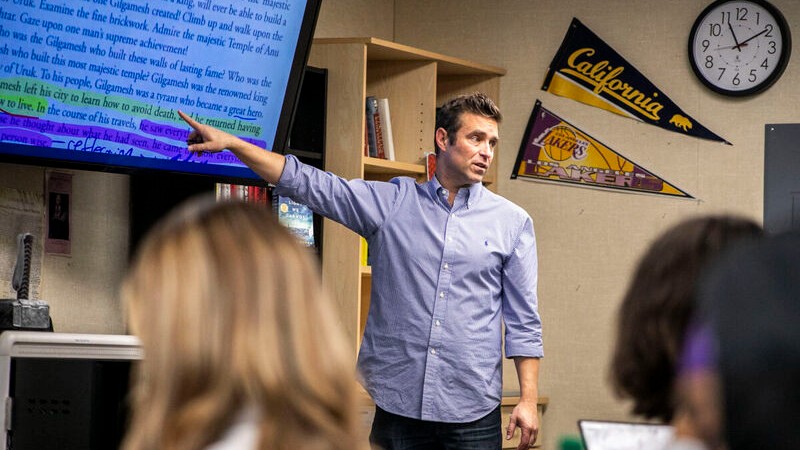
In Cuny’s classroom, he doesn’t ask his students “Any questions?”—but “What ARE your questions?” as he waves his hands, palms upraised toward his chest, inviting them to speak up.
Cuny teaches 10th‑grade Honors English and Senior Mythology at Valencia High School in Santa Clarita, California. He memorizes each student’s name by Day 2 and calls his approach “rigor through relationships.” Underpinning his approach is a simple belief: the key unlock in education isn’t more impersonal content; it’s sparking in each student the urge to ask and engage.
That conviction is why Cuny’s favorite use of AI is the Elaboration Conversation: a structure that turns curiosity into argument. To convert interest into writing, he wrote a page‑and‑a‑half prompt that turns ChatGPT into a coach. Students begin by naming a topic they care about: anything from the NFL to Taylor Swift to contemporary music. ChatGPT responds with a claim about the topic (e.g., “Radiohead forever changed alternative rock when they incorporated electronic sounds into their music”) and a piece of evidence (e.g., their album OK Computer). Then it asks students to elaborate: prove the claim using techniques Cuny has taught—if‑then reasoning, analogy, rhetorical questions, appeals to pathos.
He ran the activity as a warmup twice a week for two weeks. The result: his students scored 23% higher than the school average on the district writing assessment. Just as important, the room sounded different—tiny keystrokes, not long groans—because every student was writing about something that actually mattered to them.
Cuny’s rule of thumb for this new tool is “Humans draft; AI feedback, humans finish.” He’ll use ChatGPT to generate tailored practice—sentences showing syntactic parallelism about the cartoon show “Gravity Falls” for one group, the NFL for another—but the feedback students receive comes from him, preserving the teacher–student bond at the heart of his rigor‑through‑relationships philosophy.
To deepen inquiry, Cuny pairs AI with discussion. Before a class, students must hold at least three Socratic back‑and‑forths with ChatGPT, then close their laptops and speak from what they learned.
Cuny’s big bet: AI can catalyze a shift to the inquiry‑driven classrooms that research has long favored. “We’ve always wanted students to write more than we teachers can grade,” he says. “Now they can, and they’ll care about it.”