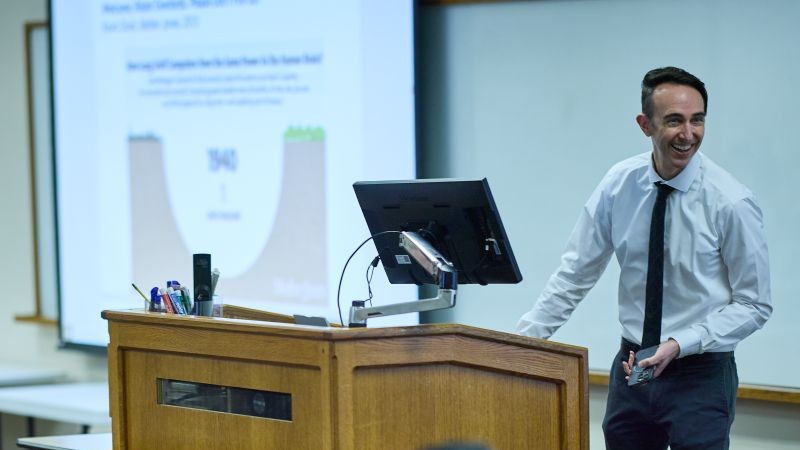
How a college instructor uses ChatGPT to run live Socratic quizzes and redesign evaluation for the AI era
With ChatGPT, law-school instructor Sean Harrington is rebuilding student assessment for the AI era. Sean—who teaches students AI and law at the University of Oklahoma and holds both a JD and an MS in Data Analytics—saw a core problem the moment generative AI went mainstream: traditional take-home exams no longer reveal what students really know.
“Take‑home essays don’t work anymore,” he says.
His answer was to use ChatGPT to build a Socratic quizbot that runs live at the start of each class. Harrington uploads the week’s readings and the bot conducts a 10‑minute, one‑on‑one oral-style exchange with each student. No two quizzes are the same. Students type back and forth, ask for clarifications (“can you rephrase the question” or “please break this into steps”), and get grilled about how they should apply rules, distinguish cases, and reason through hypotheticals. The transcripts are then shared with Harrington, giving him a fine‑grained map of each student’s understanding. For example, when he saw the class’s intense curiosity about intellectual property, he added two weeks of IP focus to the syllabus—evidence that assessment can double as a real‑time feedback loop to tailor a curriculum. Sean also open‑sourced the quizbot on Github, inviting other legal educators to adapt and use it.
Harrington, who serves as Director of Technology and Innovation at OU’s school of law, has a remit that extends beyond the classroom. OU Law requires legal‑tech training across all three years, and he helps students build custom GPTs for studying: flashcards, practice essays, even culturally tuned analogies for international classmates. On the operations side, he’s helping other teams tackle complicated paperwork and other overhead. A “Sorting Hat”-like assistant assigns students to balanced cohorts or “houses” in the school in minutes rather than days. A scheduling helper ingests constraints like room sizes, faculty availability, enrollment caps, and then produces workable timetables with room assignments. For university funding proposals, he built a reusable assistant that aligns drafts to OU and College of Law strategic plans to clear bureaucratic gates.
For Sean, the throughline is pragmatic modernization: keep the pedagogical rigor while reducing the friction. Live, individualized Socratic quizzing preserves the formative stress test of law school while shifting it from public spectacle to more personalized engagement. Faculty gain visibility they never had; students gain agency and frequent, targeted challenges; and ChatGPT restores signal to assessment.
For Sean, AI isn’t a shortcut – it’s a precision instrument to provide students with a better education.