
Article
September 9, 2026
Before DC wakes up: A fictional tourism campaign case study
# Government
# ChatGPT
Eight motion prompts to help government teams imagine a more welcoming visitor experience.

Laura Keenan
GOVERNMENT · ILLUSTRATIVE CASE STUDY · WASHINGTON, DC
A weekend visitor can picture the Washington Monument. But can they picture a whole day in DC—a morning walk, a local story, a garden, and somewhere to pause? This fictional case study explores how a government tourism team could use motion prompts to turn that question into a campaign.
“Before DC wakes up” is an illustrative exercise for state and local government teams working to attract visitors and encourage exploration. No agency commissioned or ran this campaign. There are no measured tourism results. The eight AI-generated storyboards below show a proposed creative approach, not playable animations or real footage.
DC provides the setting; the method can travel. Change the landmarks, audience, and visitor experience to explore a campaign for your own community. The prompts are starting points for creativity, not a fixed formula.
The challenge: Give visitors a reason to explore more
The hypothetical brief is to help prospective visitors imagine a fuller DC visit and take a next step toward planning it. The team wants to connect recognizable landmarks with quieter discoveries, rather than leave the campaign at a single scenic image. This is the creative challenge for the exercise, not a researched finding about DC visitor behavior.
The audience: A visitor choosing how to spend a weekend
The primary audience is someone considering a weekend in DC who wants a mix of outdoor time, cultural discovery, and ways to get around. Nearby day-trippers and international visitors are secondary audiences. Each version would need appropriate language, pacing, access details, and planning links.
The campaign idea: Your route. Your discovery. Your DC.
The story begins before the city gets busy and invites the viewer to imagine the day ahead. A landmark establishes the destination; smaller experiences give the day variety; a clear invitation points toward a verified visitor guide.
The creative hypothesis is that showing connected experiences could make a visit easier to picture and motivate trip planning. The team would test that idea with prospective visitors before investing in a full campaign.
The proposed creative package
The package could include a short opening film, individual social clips, a readable campaign end card, and static alternatives. The eight techniques below are a set of creative options. A final film would use a few selected techniques, while others could support separate posts.
These images are DC-inspired concepts. The miniature circuit, reading display, bench design, and campaign mark are invented; landmark views are illustrative rather than precise location records. Use verified references and approved assets when producing a real destination campaign.
The creative approach: Eight motion prompts
Use these visual prompting techniques to describe the style or effect you want. Ask an approved image tool for storyboards or keyframes, then develop actual motion in an approved video or animation workflow. Each example below includes a copyable storyboard prompt, production guidance, and an adaptation for another agency.
1. time lapse: Begin with a DC morning
The Washington Monument anchors three views of the National Mall as the light shifts from predawn to morning. The opening invites a visitor to imagine starting the day outside. A DC-themed tourism campaign could use this mood to lead into a verified guide to exploring the area.
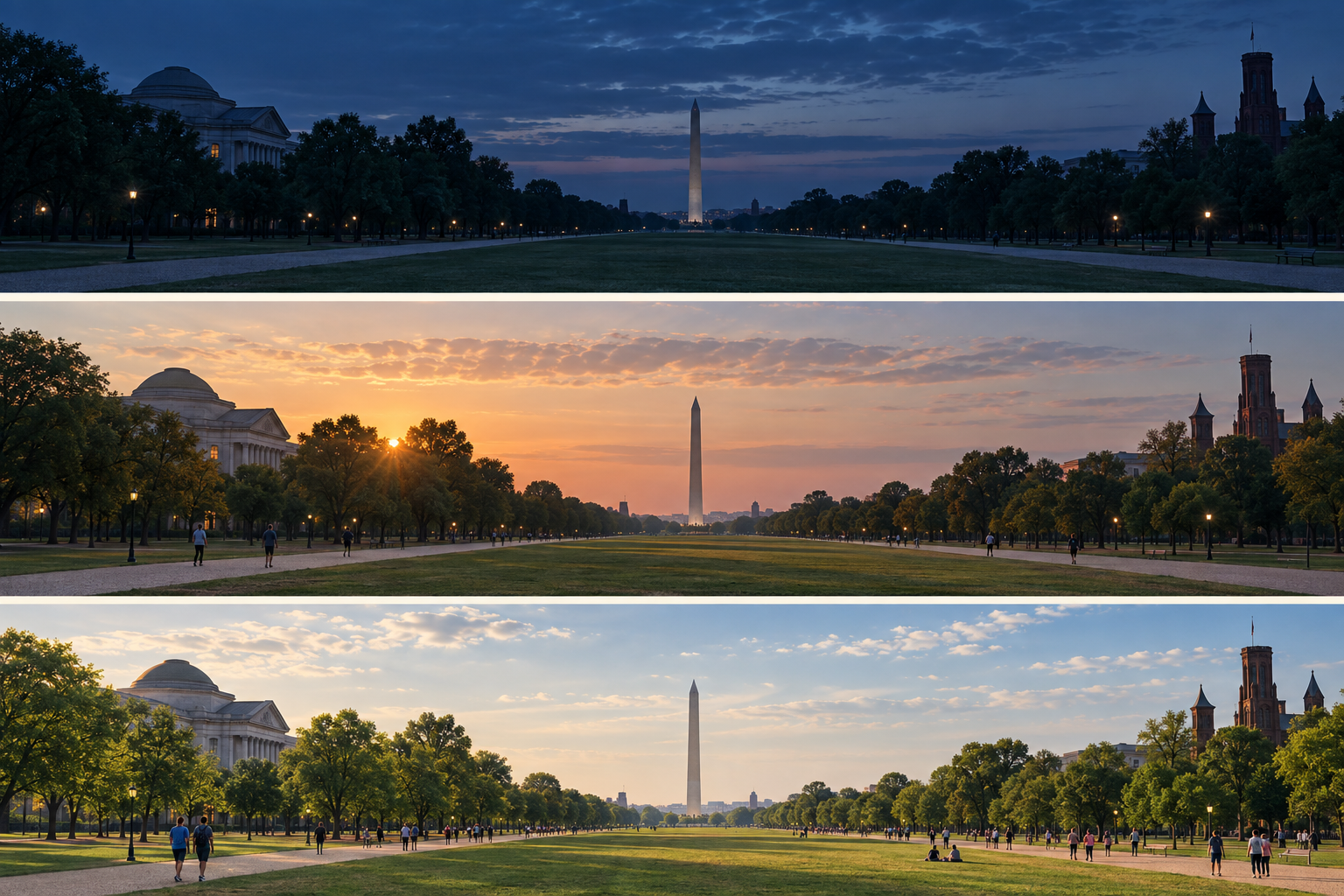
AI-generated static storyboard for the fictional campaign. Three illustrated National Mall views with the Washington Monument show a progression from predawn to morning.
Try this storyboard prompt
time lapse Create a static three-frame storyboard for time lapse, three wide strips stacked vertically with cream gutters. Washington DC National Mall looking toward the clearly recognizable Washington Monument, broad lawns, elm trees, gravel paths, flat DC terrain and low neoclassical Smithsonian museum silhouettes at edges. Identical fixed camera all three frames. First predawn blue hour almost empty, second soft sunrise first walkers, third bright morning visitors walking and enjoying the landscape. Realistic architectural proportions and recognizable Washington Monument obelisk; no invented cafes, fountains, bus shelters, or commercial stands on the Mall. Elegant photographic concept art, cinematic dawn lighting, teal green gold. No words logos or seals. AI concept of DC not documentary footage.
Plan the motion
Read the three frames from top to bottom. Compress the change from predawn to morning while keeping the viewpoint stable. For documentary use, work from actual footage of the place and period shown.
Refine it
Keep the Washington Monument and camera fixed. Change the light and visitor activity gradually, preserving the open landscape.
Adapt it for your agency
A city could introduce a morning in its historic district; a state tourism team could feature a town square; a federal visitor site could show its public grounds opening. For a real destination, use verified imagery and accurate seasonal or opening information. Pair the sequence with a link to plan a visit.
2. stop motion: Turn DC stories into a discovery
Books, a miniature Washington Monument, and a little reading chair form a playful DC-themed display. This could introduce the idea of exploring local stories alongside familiar landmarks. The miniature is a creative prop, not a depiction of an actual library or visitor-center collection.
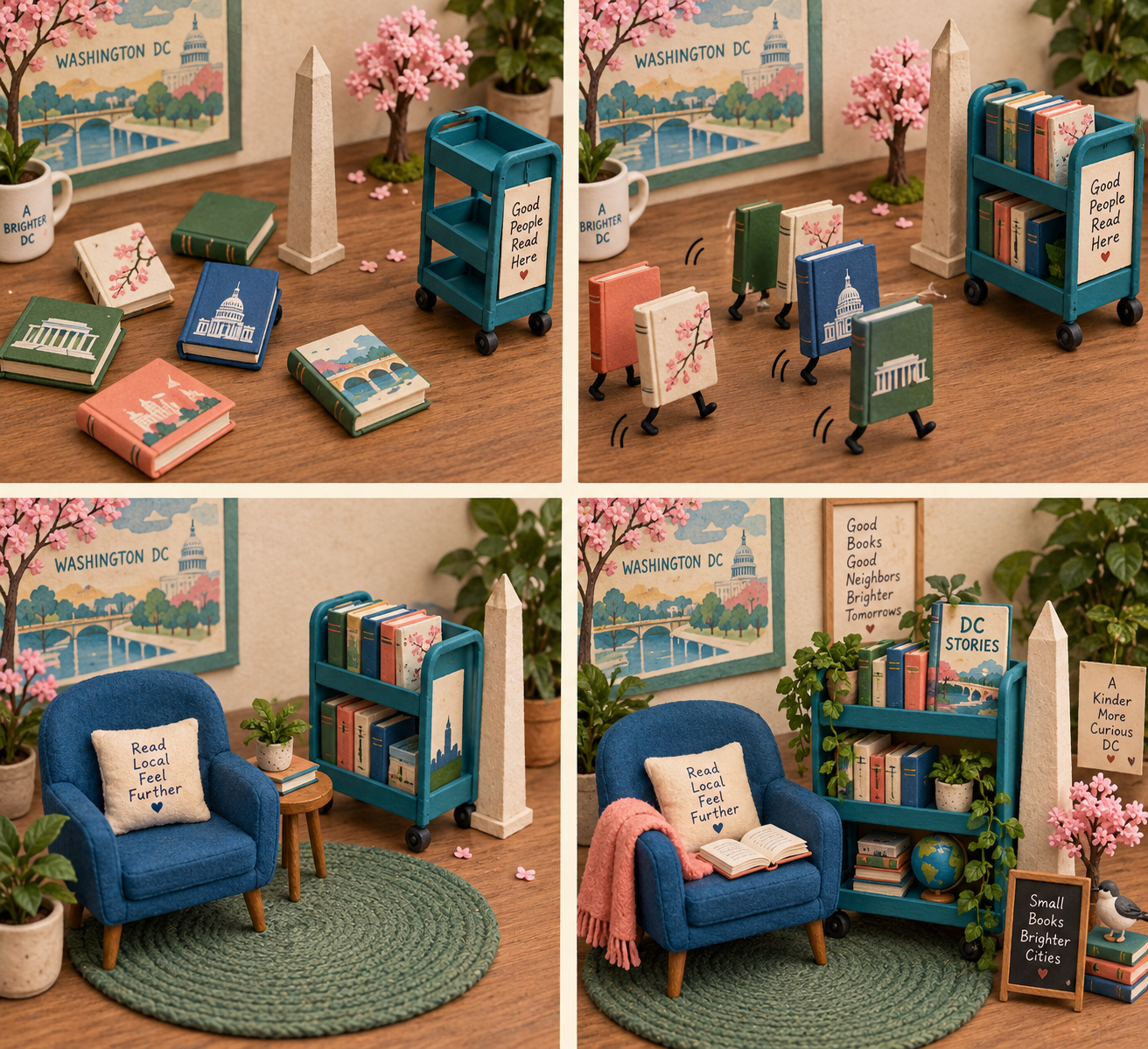
AI-generated static storyboard for the fictional campaign. Four handcrafted miniature frames arrange books, a Washington Monument bookend, and a reading nook.
Try this storyboard prompt
stop motion Create a static four-panel 2x2 stop motion storyboard with cream gutters. Tactile clay-and-paper Washington DC travel discovery tabletop, fixed overhead-oblique camera. Panel1 scattered small books, miniature Washington Monument obelisk, tiny cherry blossom tree and teal book cart. Panel2 books step toward cart and miniature DC landmark moves beside it. Panel3 books arranged, small blue reading chair arrives. Panel4 cozy finished miniature local-history reading nook, cart, chair and Washington Monument miniature as a playful bookend. Clear discrete steps, consistent objects, handcrafted texture, cream teal blue green and coral. Only optional exact book cover text DC STORIES, no official logos or agency seals. Fictional display inspired by DC, not an actual library interior.
Plan the motion
Read the grid left to right, then top to bottom. Animate the props in visible small steps, with brief holds. The stepped cadence is intentional; a smooth floating camera would tell a different visual story.
Refine it
Preserve the same DC miniature and books across the sequence. Use small, deliberate steps and avoid introducing unexplained extra objects.
Adapt it for your agency
A city could spotlight a library’s verified local-history collection, a state heritage team could feature interpretive materials, or a federal museum could introduce objects visitors can explore. Confirm public access and available experiences. The goal is to make a specific discovery inviting, not imply every library offers a tourism program.
3. seamless loop: Suggest a day of connected experiences
A bus circles a simplified DC-inspired scene containing a museum and Washington Monument miniature. The loop suggests the possibility of exploring without a car. Its geography and transport are invented: a real campaign should link to current journey-planning information rather than ask viewers to navigate from this image.
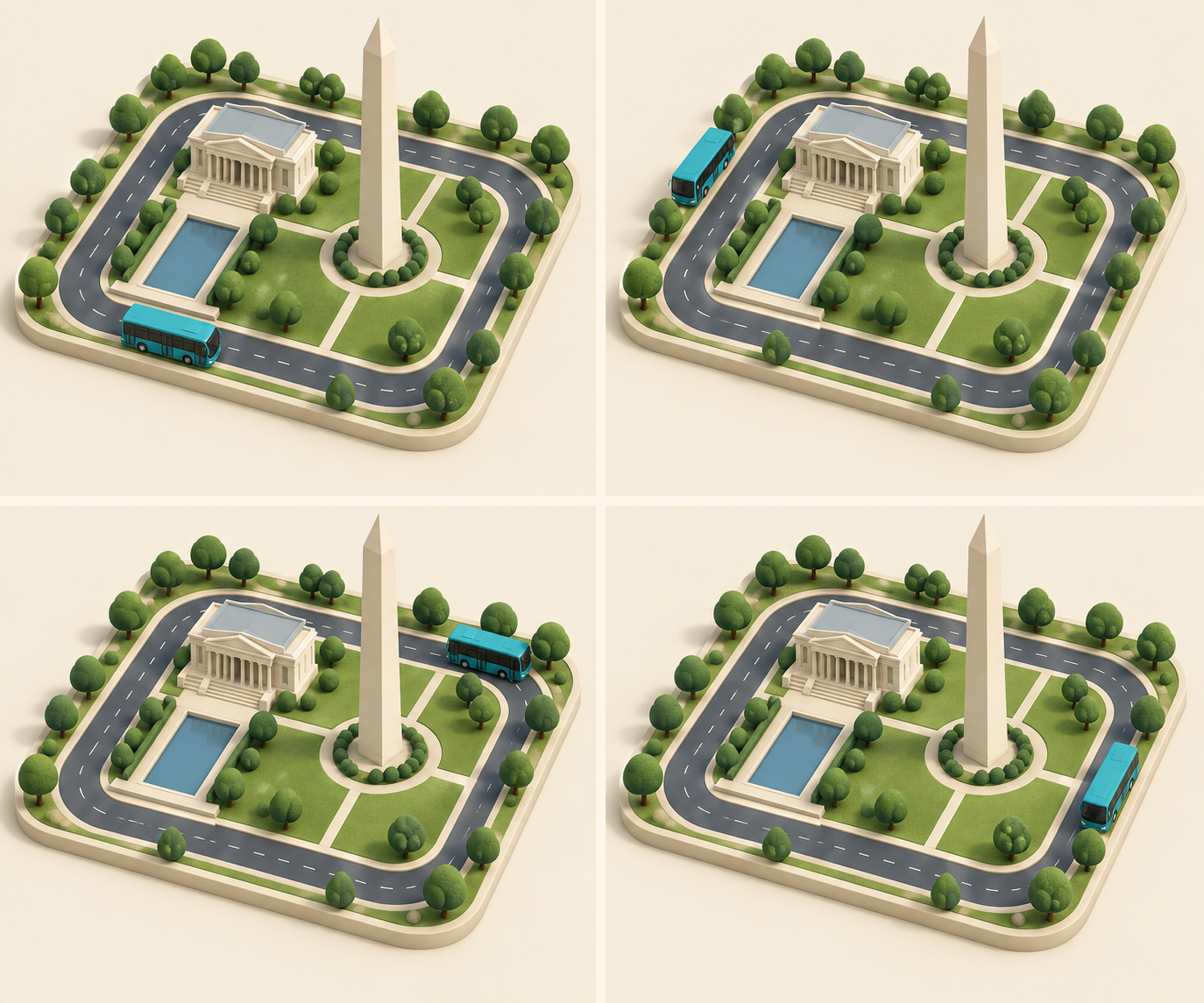
AI-generated static storyboard for the fictional campaign. Four miniature storyboard frames show an unbranded bus around an imaginary DC-inspired visitor circuit.
Try this storyboard prompt
seamless loop Create a static four-panel 2x2 storyboard for seamless loop with cream gutters. A stylized imaginary Washington DC visitor circuit, explicitly conceptual geography: cream background, small neoclassical museum, a miniature Washington Monument obelisk and green lawns inside a rounded rectangular road. One teal generic bus on road in each panel changes position clockwise. Fixed identical isometric miniature camera and architecture all panels. Last bus position matches first at bottom left. Stylized tactile 3D graphic, simplified buildings, teal blue cream green. No bus agency branding, actual route numbers, text, maps, flags or seals. This is a DC-inspired metaphor, not an actual route map.
Plan the motion
Matching endpoints is only the start. Check the direction and speed across the join so the motion does not jump or pause. The storyboard proposes a loop; the finished animation needs playback review.
Refine it
Match the opening and closing bus positions precisely. Keep the scene fixed, and make the bus travel continuously in one direction.
Adapt it for your agency
City and state tourism teams could pair an animated overview with verified transit links, fares, operating hours, and stop information. A federal visitor attraction could explain how to reach it through actual transport options. This fictional block is not a navigation map or a promise of frequent service.
4. product assembly reveal: Make the pause part of the visit
An imagined bench comes together with the Washington Monument beyond it. The reveal ends on a simple experience: somewhere to stop and enjoy the setting. A tourism team could use the idea to introduce a slower-paced visit, then identify actual places and amenities through verified information.
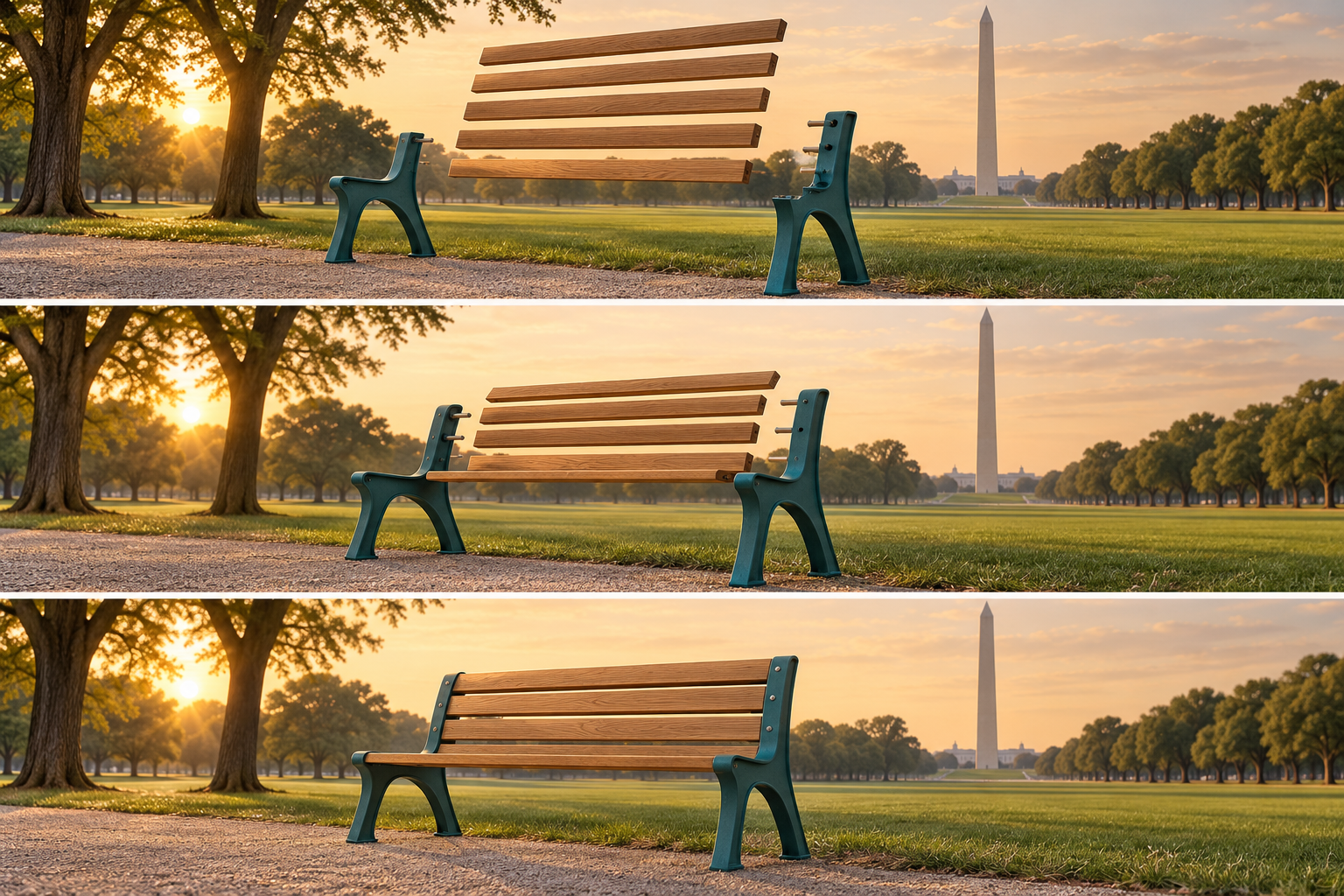
AI-generated static storyboard for the fictional campaign. Three DC-inspired concept frames assemble an invented bench with the Washington Monument in the distance.
Try this storyboard prompt
product assembly reveal Create static product assembly reveal storyboard, three wide frames stacked with cream gutters. Washington DC inspired public bench concept near a broad lawn with recognizable Washington Monument in distant background and elm trees. Same fixed camera. First two teal metal bench supports and five oak slats float separated near final positions. Second pieces come together. Third finished bench firmly rests beside a gravel path. Conceptual simple bench identical all frames. Golden sunrise, photoreal 3D concept, flat National Mall landscape. No imaginary skyscrapers, water, other landmarks, people, words or official logos. Clearly concept art for tourism storytelling not actual installed amenity or construction instructions.
Plan the motion
Reveal a few large components in a clear order, then hold the completed object. If the subject is an actual product or public installation, work from approved references so the reveal represents it accurately.
Refine it
Keep the same bench and landmark scale. Settle each component into place and hold the completed view.
Adapt it for your agency
A city could feature places to pause along a visitor walk; a state destination team could introduce a public overlook; a federal garden could highlight a rest area. Use verified references when showing actual amenities. A bench in a concept image does not establish step-free access, shade, or other facilities.
5. match cut transformation: Move from arrival to discovery
A bus wheel cuts to a bicycle wheel with the Washington Monument beyond, then to a circular garden detail. The shared shape connects three experiences in a DC-themed day. Smithsonian Gardens provides a real reference for garden discovery; this particular flower bed remains an invented visual, not an identified garden.
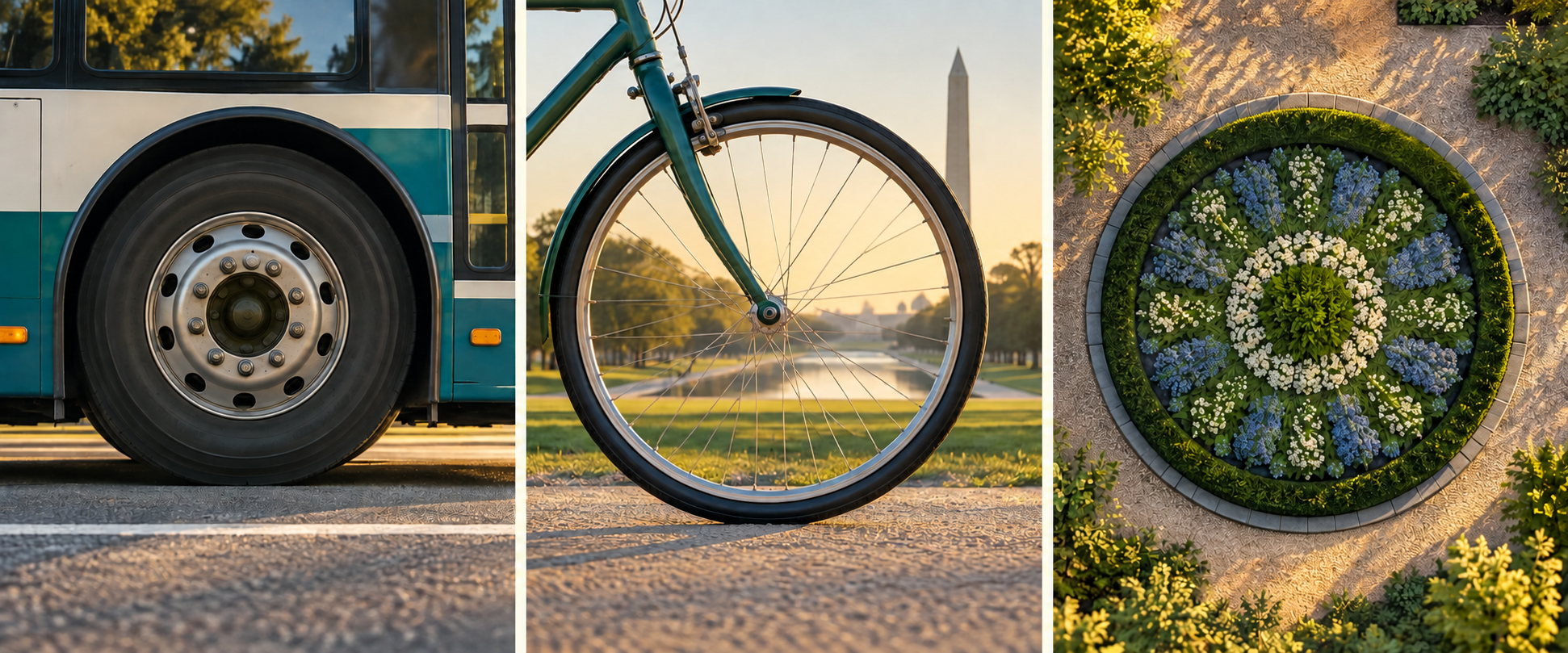
AI-generated static storyboard for the fictional campaign. A bus wheel, a bicycle wheel near the Washington Monument, and an imagined garden circle form matching compositions.
Try this storyboard prompt
match cut transformation Create a static three-panel horizontal triptych storyboard for match cut transformation with thin cream gutters. Washington DC tourism concept connecting different experiences through matched circles. Panel1 centered large wheel of an unbranded city bus, panel2 centered bicycle front wheel near DC's National Mall with Washington Monument softly visible in background, panel3 overhead centered circular ornamental flower bed inspired by a public museum garden, no claim of exact actual garden. All circles exactly same center and scale. Realistic editorial photography, lovely golden morning light, green teal blue cohesion. No text, logos, transport brands or seals. Illustrative AI storyboards not real photos.
Plan the motion
Cut between the matching compositions at a deliberate moment. A match cut can be a clean edit between scenes; it does not require the objects to melt or morph into each other. If matching movement too, preserve its direction.
Refine it
Align the circles at the same size and center. Keep the Washington Monument subtle enough that the wheel remains the focal point.
Adapt it for your agency
City and state tourism teams could connect cultural stops, transport, and outdoor spaces. A federal museum could match an exhibit detail with a feature of its surroundings. Ground any published itinerary in real distances, transport options, and access information; a visual transition does not prove two destinations are conveniently connected.
6. logo reveal: Give the invitation a DC sign-off
A sun and obelisk shape resolve into an original campaign mark above “WASHINGTON, DC” and “READY FOR YOUR DAY.” This fictional sign-off gives the sequence a sense of place. A published agency campaign would use its approved identity and a clear link to visitor information.
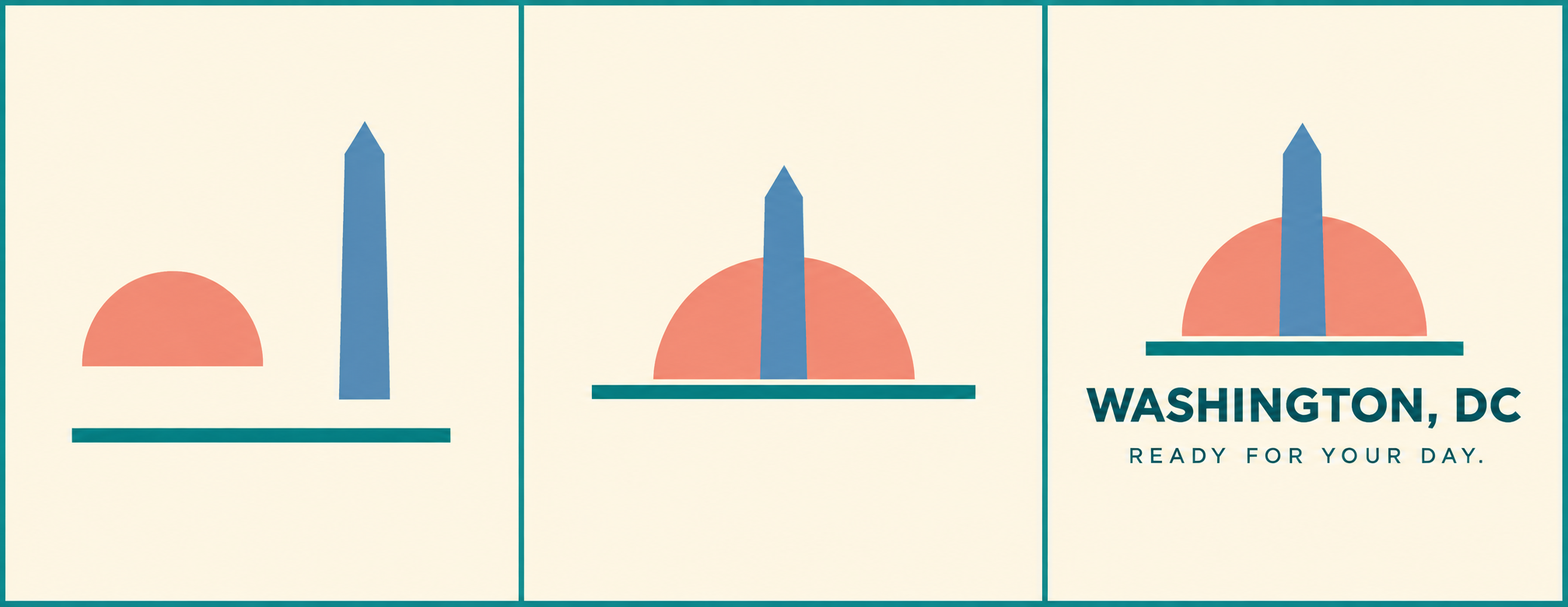
AI-generated static storyboard for the fictional campaign. Three frames assemble a fictional DC-inspired campaign mark with “WASHINGTON, DC” and “READY FOR YOUR DAY.”
Try this storyboard prompt
logo reveal Create static three-panel horizontal logo reveal storyboard for a fictional Washington DC tourism campaign. Thin teal gutters, cream background. First separate coral rising sun, slender blue obelisk shape and teal horizontal line. Second they align into a minimal sunrise and Washington Monument inspired symbol. Third completed same simple symbol above exact dark teal text WASHINGTON, DC and smaller READY FOR YOUR DAY. Elegant flat graphic design, readable sans serif, generous white space. No official DC flag, government seal, real tourism organization logo or OpenAI mark. Original illustrative campaign concept only.
Plan the motion
Bring the shapes into alignment and settle into a still end card. In production, preserve approved logo geometry and colors. Use editable lettering for the final wording.
Refine it
Keep the final wording exact and editable in production. Reduce the moving elements and hold the finished mark for reading.
Adapt it for your agency
A city or state tourism team could close a campaign with its approved destination identity. A federal visitor program could use its authorized mark. Preserve official assets and follow identity rules; this example invents a campaign mark solely to demonstrate the technique.
7. kinetic typography: Make the message personal to the visitor
“Your route. Your discovery. Your DC.” turns a destination into an invitation to choose an experience. The sequence could connect the landmark, local-story, and garden visuals without needing a voiceover. Washington, DC remains visible in each frame so the destination is clear.
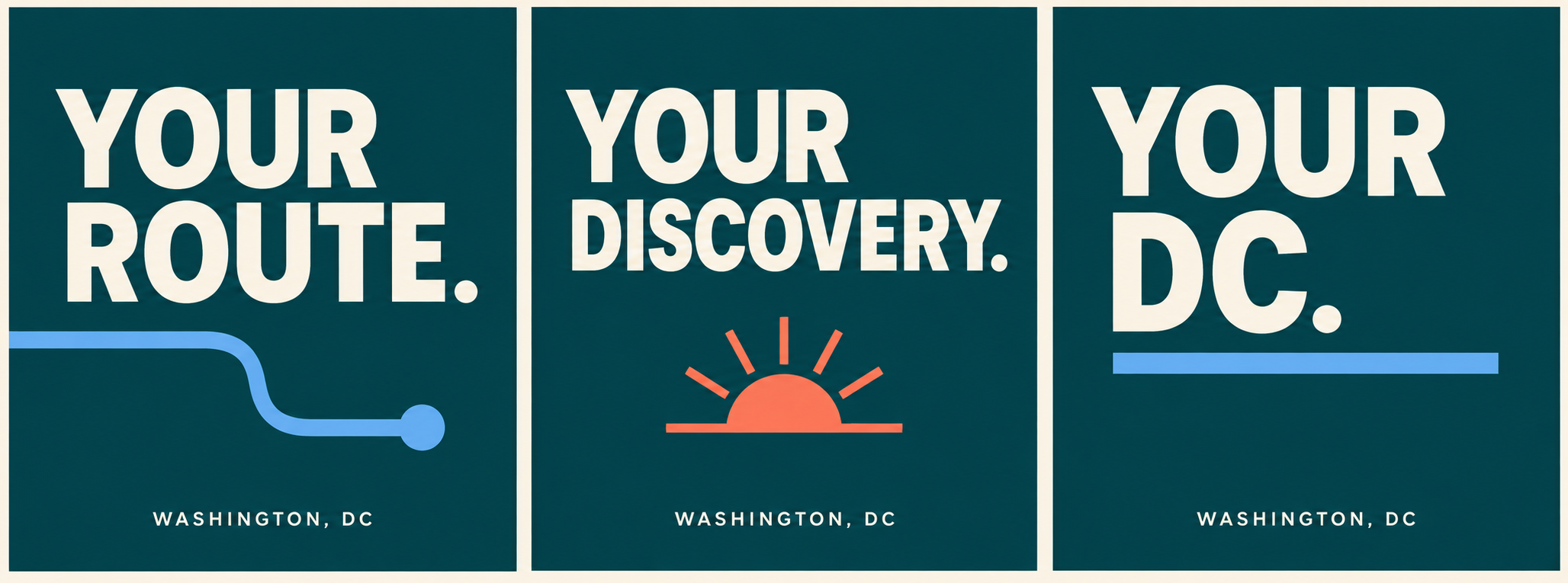
AI-generated static storyboard for the fictional campaign. Three text frames read “YOUR ROUTE.”, “YOUR DISCOVERY.”, and “YOUR DC.”, each labeled “WASHINGTON, DC.”
Try this storyboard prompt
kinetic typography Create static three-panel horizontal kinetic typography storyboard for a fictional Washington DC tourism campaign. Deep teal panels separated by cream gutters. Very large cream sans serif text in each panel: first YOUR ROUTE. with a blue path line, second YOUR DISCOVERY. with small coral rising sun, third YOUR DC. with blue underline. Exact spelling and punctuation. Each panel also contains small but legible WASHINGTON, DC at bottom. Consistent typography, high contrast, lots of breathing room, flat graphic style. No other words, logos, flags or seals. Static animation planning keyframes.
Plan the motion
Animate editable text in a video or motion-design tool. Use a measured pace and modest movement. Avoid flashing or rapid zooms, and provide the full message as static text alongside the video.
Refine it
Keep each phrase on screen long enough to read. Preserve high contrast and use gentle entrances rather than flashing or rapid zooms.
Adapt it for your agency
A tourism team could create reviewed language versions of a short invitation, with layouts and timing adjusted for each language. Pair the clip with useful written information and a clear planning link. Motion and imagery can support understanding across languages, but they do not replace translation.
8. cinemagraph: Leave a quiet DC moment with the viewer
A bench, a path, and the Washington Monument remain still while a small branch is intended to move in the breeze. The final scene invites someone to imagine lingering. It provides an atmospheric close before the campaign points to practical information for planning a visit.
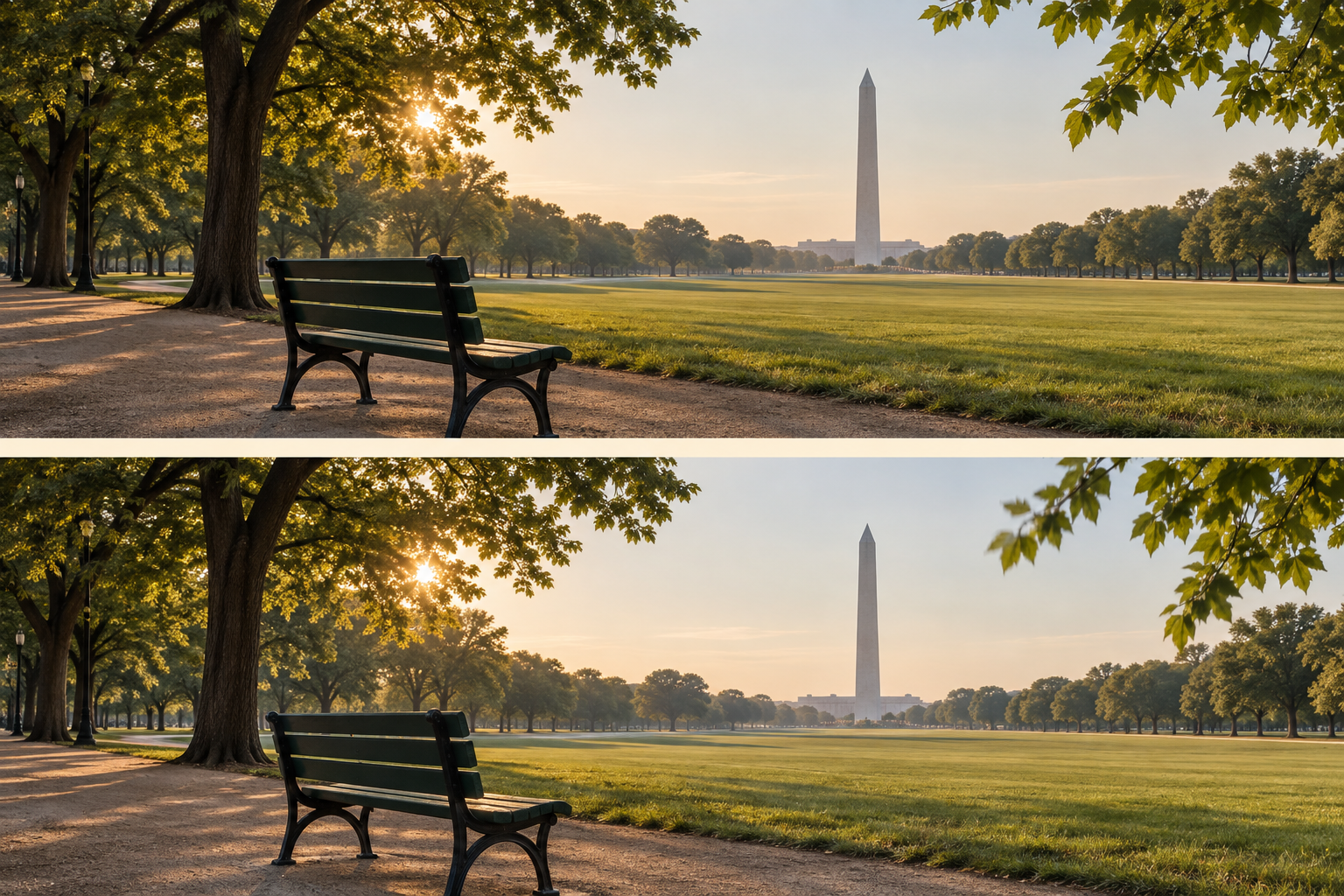
AI-generated static storyboard for the fictional campaign. Two DC-inspired park views plan subtle leaf movement with a bench and the Washington Monument beyond.
Try this storyboard prompt
cinemagraph Create two almost identical wide frames stacked vertically separated by a cream gutter for a static cinemagraph storyboard. Washington DC tourism: a quiet tree-lined path at the National Mall, a green park bench in foreground and clearly recognizable Washington Monument obelisk softly visible at a plausible distance beyond broad lawn. Warm early morning sunlight, flat terrain, no other invented landmarks. Camera, bench, monument, lighting and background identical; only a small branch of leaves at upper right shifts slightly between frames. Elegant realistic photographic concept, no people text logos flags or seals. Not actual footage, two static planning frames.
Plan the motion
Use a still base with a carefully isolated moving region. Review the edges and loop join during playback. These still frames show the intended location of movement; they do not demonstrate an actual cinemagraph.
Refine it
Freeze the camera, monument, bench, path, and light. Isolate movement to a small branch and check the edges during playback.
Adapt it for your agency
A city could introduce a quiet public garden, a state team could feature a scenic stop, or a federal visitor site could highlight a peaceful outdoor space. Show the actual place and conditions accurately in a real campaign. Pair atmosphere with the details people need to decide whether the stop suits them.
How the proposed campaign could come together
Open with the National Mall moving from predawn into morning. Use the shape-matched cuts to connect arrival, exploration, and a garden pause. End with “Your route. Your discovery. Your DC.” and a link to a verified visitor guide. The stop-motion display, assembly reveal, loop, and cinemagraph could become companion posts with their own focused messages.
Before production, ask prospective visitors what they think the campaign offers and what they still need to know. Refine any confusing scenes. Then produce the selected motion, review the final footage and wording, and confirm the planning information with the people responsible for each destination or service.
Make the invitation usable across languages and access needs
Pair the visuals with plain-language descriptions, reviewed translations, descriptive text, and captions for speech and meaningful sounds. Keep the core message available as static text. Where the format supports it, offer pause controls and respect reduced-motion preferences.
Put current destination names, hours, costs, booking requirements, transport links, and detailed access information outside the generated artwork. A visually welcoming scene does not establish that a real route or attraction suits every visitor.
How the team would measure success
These are proposed measures, not campaign results. Agree on the main goal before launch: for example, more people taking a meaningful step toward planning a visit. Track campaign links to itinerary pages, visitor-guide downloads, and referrals to participating attractions. Video views can show reach, but they do not establish an increase in tourism.
Compare performance with a suitable baseline or another campaign version, accounting for seasonality and other promotion. Visitor research or partner data could help assess actual visits or length of stay, with the limits of attribution made clear. Do not turn engagement numbers into unsupported claims of economic impact.
The takeaway for other government teams
This case study demonstrates a way to move from a communication goal to a creative concept, illustrated prompts, a practical visitor invitation, and a measurement plan. It does not demonstrate that the campaign increased tourism.
Your community may need a different story: a small-town day trip, a regional heritage trail, an off-season visit, or a public museum experience. Start with what your audience could discover. Choose the technique that helps them picture it, then give them an accurate next step.
References for planning a real DC visit
Use official destination and site information to verify places and visitor arrangements. These links support planning research; the storyboards are not an itinerary or navigation map.
Dive in
Related
Resource
U.S. House of Representatives Prompt Pack for Communications Directors
By Laura Keenan • Sep 18th, 2026 • Views 39
Video
OpenAI OneGov 2.0: What Government Leaders Need to Know
By Alexis Bonnell • Sep 16th, 2026 • Views 284
Resource
U.S. House of Representatives Prompt Pack for Legislative Directors
By Laura Keenan • Sep 18th, 2026 • Views 20
Resource
U.S. House of Representatives Prompt Pack for Communications Directors
By Laura Keenan • Sep 18th, 2026 • Views 39
Resource
U.S. House of Representatives Prompt Pack for Legislative Directors
By Laura Keenan • Sep 18th, 2026 • Views 20
Video
OpenAI OneGov 2.0: What Government Leaders Need to Know
By Alexis Bonnell • Sep 16th, 2026 • Views 284