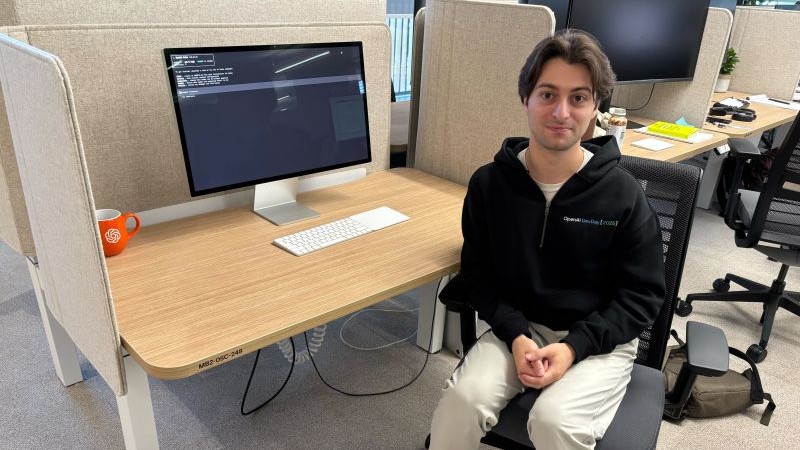
How Codex helps an OpenAI researcher turn training data into interactive signals and new techniques
OpenAI’s coding tool Codex accelerates AI research by turning Aidan McLaughlin’s hypotheses into interactive front‑end visualizations that surface hidden signals and catalyze new training techniques. Aidan was in attendance at OpenAI’s DevDay, and his approach reflects how software engineers and researchers across the company are scoping goals, asking Codex to plan and scaffold a function or app, and iterating fast with AI as a collaborator—which is why we’re showcasing his work this week.
Aidan McLaughlin is an AI researcher on OpenAI’s core models team whose work spans training experimentation, dataset curation, and research in reinforcement learning. Ever since Codex’s upgrade last summer, the coding tool has helped accelerate his work, not as an auto‑pilot, but as a way to rapidly upskill on front‑end development and turn analytical ideas into interactive instruments.
Aidan’s pattern is straightforward: describe the analytical goal, let Codex scaffold a browser app, then iterate conversationally. He still leans on Python and SQL for analytics, but now relies on Codex to draft the HTML/CSS/JavaScript that transform raw outputs into clickable, comprehensible views. Over the past month, roughly 40% of his code has been front‑end work that he was less familiar with, and that he once would have queued up for “later.”
A recent project crystallizes the shift. Instead of stitching together notebooks and ad‑hoc queries to probe a large training dataset, Aidan asked Codex to “build a website that visualizes this end‑to‑end.” In about an hour—completing work that would have normally taken weeks—he had a polished dashboard: class‑level summaries, drill‑downs into raw data, and inline context for each record. That interface made a previously fuzzy signal obvious. While the exact signals he was working on have to stay internal, their prevalence was clear enough to change the team’s questions from “does this exist?” to “how should we train on it?” The result was a new line of training techniques.
Codex also collapses dependencies in day‑to‑day research. Aidan can just “talk to the codebase,” asking for explanations of components, data flows, or diffs, and request simpler summaries if needed. That judgment‑free loop—from intent to generation to visualization to explanation—removes bottlenecks like waiting for an answer from the original author of long-running code, or hand‑coding boilerplate for weeks. When a visualization is one click away, colleagues can align on what the data says with less doubt and debate, and move sooner to experimental design. Teamwide consensus based on a shared understanding gets easier.
For Aidan, Codex supplies the scaffolding and stamina to explore broadly and refine quickly. The payoff is better questions, quicker consensus, and research that moves a little closer to the speed of thought.