
OpenAI Academy
Article
December 19, 2025

Cell reprogramming for longer, healthier lives
Cell reprogramming for longer, healthier lives
# startup
# biotech

A 10-person biotech team uses OpenAI models to cut drug-discovery timelines and costs, starting with Type 2 diabetes and a Parkinson’s program narrowed from 20 targets to three.

Cell reprogramming for longer, healthier lives
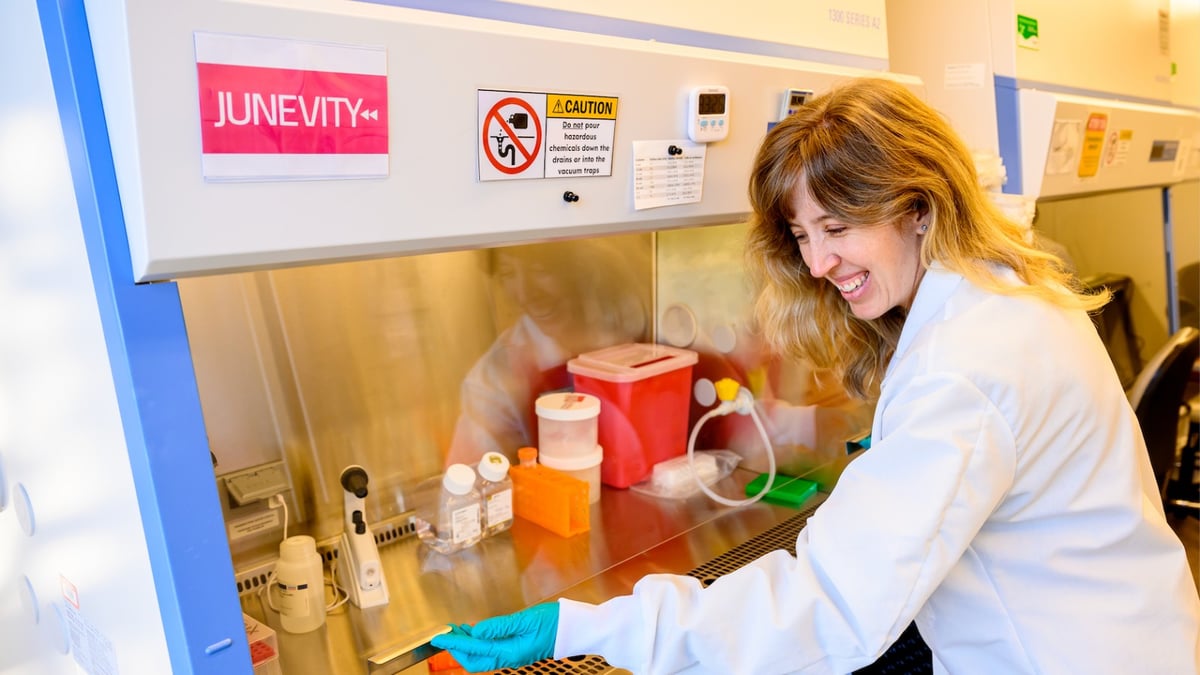
With OpenAI models, entrepreneur Rob Cahill and his colleagues are building Junevity, a business that aims to reprogram aging cells to extend human lifespan — and tackle diseases like Parkinson's. For Rob, the work is personal. In his mid‑30s, as his older mother suffered a series of falls and fractures, and as an uncle received a Parkinson’s diagnosis, he started to reconsider his career path. He had worked in software and sold a startup when the problems of aging caught his attention. Rob took night classes in biochemistry at UC Berkeley Extension, completed a master’s in bioinformatics at Johns Hopkins, then left his tech role for a pay cut to work in a University of California San Francisco lab, initially for free, reading papers alongside graduate students. That led him to scientist Janine Sengstack and transcription‑factor expert Hao Li at UCSF, who had shown that silencing certain “manager genes” could broadly reset gene expression in aged cells. Together with veteran biotech CEO John Hoekman, Janine and Rob co‑founded Junevity to reprogram aging cells with small interfering RNA (siRNA), starting with metabolic disease and neurodegeneration. AI has been part of the company’s operating system since its foundation. “From the day we started, we decided to be AI‑enabled in every way possible,” Rob said. Every employee receives a paid ChatGPT subscription on arrival, and the company layers OpenAI models on top of more traditional machine‑learning pipelines for genomics data. Rob estimates that nominating Junevity’s first development candidate, a liver‑targeted siRNA program for Type 2 diabetes and obesity, will cost 2-6x less in development costs than typical industry budgets to reach the same milestone. Timelines have compressed as well, roughly two to three times faster than industry norms, which lets the 10‑person team push more programs forward with the same capital. But the clearest example sits in Junevity’s Parkinson’s effort. The company’s discovery platform had identified 20 transcription‑factor targets that might make the aging brain better at clearing toxic proteins. Manually tracing each target’s genetic link to human disease across the literature would have taken “months.” Instead, the team built a ChatGPT‑driven workflow that applies structured prompts to every target, scoring genetic evidence and returning linked papers. “ChatGPT helped us narrow it to three targets from 20,” Rob said, and those three are now being tested in animal models. “The faster we bring these drugs to patients, the faster we’ll see an impact on healthspan and lifespan.” Junevity’s way of work exemplifies a different way to do drug development, where compact teams use AI to widen the search for therapies while shrinking the cost of each shot on goal. For Rob and his co-founders, AI is the leverage that turns whole‑body, preventive cell reprogramming into an executable plan, and takes it from science fiction to a well-grounded hope.
Dive in

Related

Resource
MCP for Builders
Aug 7th, 2025 Views 12.1K
Resource
ChatGPT for product
Jul 21st, 2025 Views 181.6K
Resource
Codex for Builders
Aug 7th, 2025 Views 11.4K
Resource
ChatGPT for sales
Jul 21st, 2025 Views 170.4K
Resource
MCP for Builders
Aug 7th, 2025 Views 12.1K
Resource
Codex for Builders
Aug 7th, 2025 Views 11.4K
Resource
ChatGPT for sales
Jul 21st, 2025 Views 170.4K
Resource
ChatGPT for product
Jul 21st, 2025 Views 181.6K
Terms of Service